- The First Rule of Reef Fish ID (That Most Divers Ignore)
- What Are the Key Field Marks for Reef Fish Identification?
- Top 5 Reef Fish Families You Will Meet (and How to Tell Them Apart)
- How to Use Behavior for Marine Life Identification
- Common Reef Fish Identification Mistakes (and How to Fix Them)
- How to Practice Reef Fish Identification Before Your Next Dive
- Reader Questions: Real Scenarios from the Reef
I still remember the first time I tried to identify a small blue fish on a Maldivian reef. I flipped through a waterproof card, convinced it was a blue chromis. A divemaster glanced over, shook his head, and pointed out the faint black spot at the base of the tail. That was a damselfish. That tiny mark changed how I look at every fish.
Reef fish identification is not about memorizing hundreds of species. It is about knowing where to look and when to look. This guide gives you the exact steps I use after a decade of diving and leading fish surveys.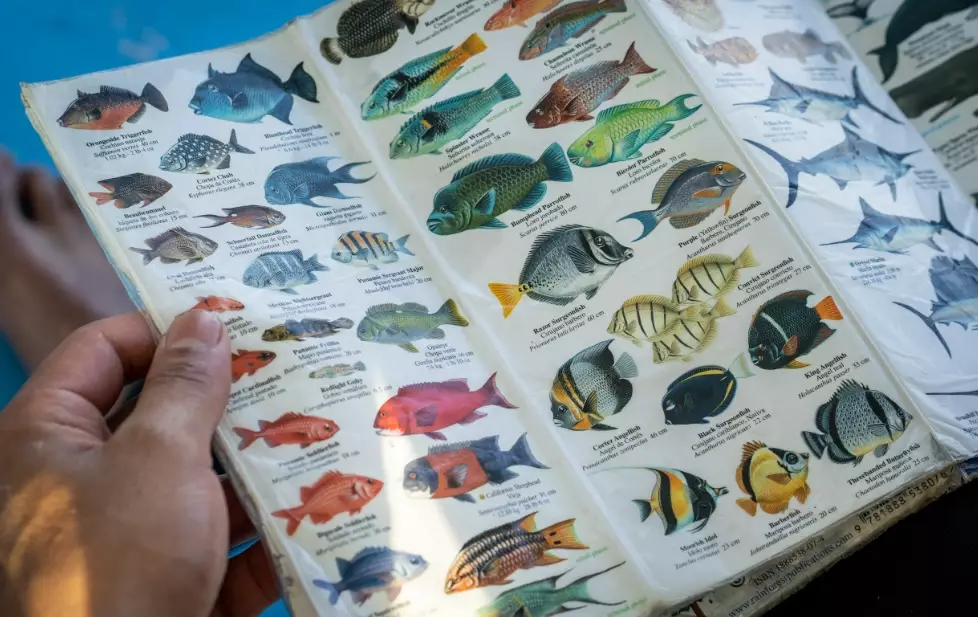
The First Rule of Reef Fish ID (That Most Divers Ignore)
Forget the color. Seriously.
Color is the most misleading cue underwater. Red light disappears at depth, so a fish that looks orange on the surface might be brown at 20 meters. Many species also change color with mood, age, or sex.
What actually works? Body shape, fin placement, and behavior. Those three rarely lie.
On a reef in Raja Ampat, I watched two divers argue over a fish. One said anthias, the other said wrasse. Both missed the giveaway: the fish hovered in open water, facing upstream, waiting for plankton. That is classic anthias behavior. A wrasse would be poking around the coral rubble.
So before you even think about color, ask yourself: How does this fish move? Where does it hang out?
What Are the Key Field Marks for Reef Fish Identification?
Here is the checklist I run through in my head, in this order:
- Body shape – torpedo, deep-bodied, flattened, or eel-like?
- Tail shape – fork, crescent, round, or square?
- Fin position – does the dorsal fin run the whole back or just part of it?
- Distinct markings – spots, stripes, bars, or false eyes?
- Eye size and position – large and forward (predator) vs small and side (prey)?
Try this on your next dive: pick one fish and just note the tail shape. Then look at the mouth. You will be surprised how quickly you narrow down the family.
Top 5 Reef Fish Families You Will Meet (and How to Tell Them Apart)
These five families show up on almost every tropical reef. Learn them and you will identify most of what you see.
| Family | Key ID Feature | Typical Behavior | Common Confusion |
|---|---|---|---|
| Damselfish (Pomacentridae) | One continuous dorsal fin, small mouth, often territorial | Hover near coral heads, dart at intruders | Easily confused with chromis (which are also damselfish but behave differently) |
| Wrasse (Labridae) | Thick lips, prominent front teeth, vary wildly in color | Constant motion, picking at substrate | Juveniles look nothing like adults |
| Butterflyfish (Chaetodontidae) | Disk-shaped body, pointed snout, often in pairs | Slow, deliberate swimming, pecking at coral | Similar to angelfish but lack a spine on the gill cover |
| Snapper (Lutjanidae) | Deeper body, large mouth, often red or silver | Hover mid-water, sometimes in schools | Can resemble groupers but snapper have a more streamlined head |
| Grouper (Serranidae) | Large mouth, thick body, rounded tail | Ambush predators, often stationary near structure | Some mimic blennies or gobies |
I have seen divers mistake a juvenile damselfish for a completely different species because they only looked at the bright blue color. The dorsal fin told the real story.
How to Use Behavior for Marine Life Identification
Behavior is your secret weapon. Fish do not read field guides, but they act predictably.
Feeding style: A fish that takes bites out of the coral surface is likely a parrotfish or a butterflyfish. One that picks plankton from the water column is probably an anthias or a chromis. A fish that sits motionless on a coral head and then lunges is a grouper or a hawkfish.
Social grouping: Pairs often indicate butterflyfish or some angelfish. Large schools? Snapper, grunts, or fusiliers. Solo? Often a wrasse or a grouper.
Reaction to you: Damselfish will often aggressively defend their patch. They will swim right at your mask. Wrasses will keep a distance. Groupers may hold their ground.
My rule of thumb: Watch a fish for 30 seconds before you try to name it. Its behavior will tell you more than a single glance ever could.
Common Reef Fish Identification Mistakes (and How to Fix Them)
These are the ones I see repeatedly, even from experienced divers.
- Relying on color alone. Fix: Always note body shape and fin layout first.
- Ignoring juveniles. Many species look completely different as juveniles. Fix: Learn the juvenile patterns of common species in your region. A tiny, bright yellow fish with black spots is likely a juvenile damselfish, not a separate species.
- Assuming one name fits all. Fix: Get comfortable with “fish from the wrasse family” rather than a precise species. That is often good enough for a dive log.
- Forgetting depth and location. Fix: Note the depth and habitat (reef flat, wall, sandy patch) because many species are zone-specific.
On a night dive in Palau, I saw a fish that looked like a goby. It had the body shape and the big eyes. But something felt off. I checked the dorsal fin—it had two separate parts. That is a blenny, not a goby. The lesson? Check the fins.
How to Practice Reef Fish Identification Before Your Next Dive
You do not need a marine biology degree. A few focused habits will make you better than most divers on the boat.
Build a mental library: Pick one family per week. Look at photos online, note three field marks, and then try to spot that family on your next dive.
Sketch what you see: Even a rough drawing forces you to notice details you would otherwise miss. My sketchbook is full of badly drawn fish that taught me more than any course.
Use a slate: Write down the depth, behavior, and one standout feature immediately after surfacing. Your memory fades fast.
Go with a local guide: They know the resident fish individually. I once watched a guide point out the same coral trout on every dive. He knew its territory. That kind of knowledge is gold.
And here is a non-consensus tip: Do not try to identify every fish you see. Focus on three or four per dive. You will remember them far better.
Reader Questions: Real Scenarios from the Reef
This article was fact-checked against standard reef fish identification resources and my own dive logs.


Leave a Comment